
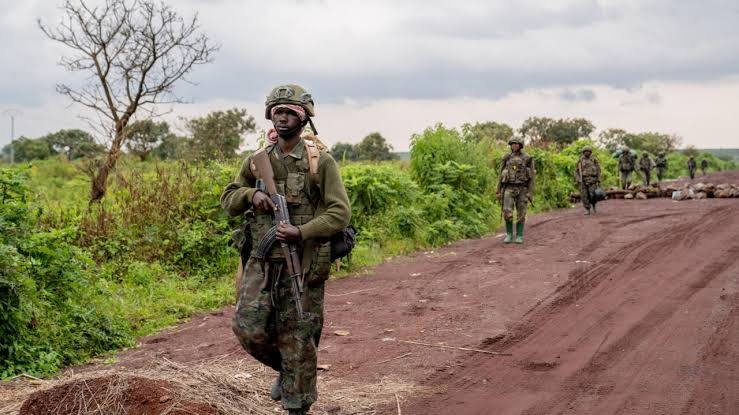
In a stunning and ominous development, M23 rebels have launched a bold assault on the eastern Democratic Republic of Congo, successfully breaching the defences of the strategic city of Bukavu. This brazen incursion marks a significant escalation in the region’s protracted conflict, sparking widespread fears of an impending humanitarian crisis. As the rebels consolidate their grip on the city, the international community is urged to take immediate action to prevent further destabilization and protect the vulnerable civilian population caught in the crossfire.
M23 rebels in eastern Democratic Republic of Congo have entered Bukavu, the region’s second-largest city.
Corneille Nangaa, leader of the Congo River Alliance, which includes M23 forces, told Reuters that the rebels entered the South Kivu provincial capital on Friday evening and planned to continue their advance on Saturday.
The progress of the Rwandan-backed militants continues despite global calls for a ceasefire and the resumption of peace talks. In recent weeks, the rebel advance has displaced hundreds of thousands of people from their homes.
Last month, the Tutsi-led M23, supported by neighboring Rwanda, took control of Goma, the main city in the mineral-rich east. The Congolese government accuses Rwanda of destabilizing the region to exploit its resources, a claim that Rwanda has denied.
The M23 briefly captured Goma during a previous conflict in 2012, but taking Bukavu, the capital of South Kivu province, would mark a new phase in the region’s turbulent recent history.
The city, which borders Rwanda, is on the southern tip of Lake Kivu and is an important transit point for the local mineral trade.
Earlier on Friday, rebel fighters had entered the airport some 30km (19 miles) north of Bukavu, as the Congolese army and a militia allied with it withdrew without putting up much resistance.
But there were heavy clashes on the outskirts of Bukavu, South Kivu’s Deputy Governor Jean Elekano, had said to the BBC.
In the northern village of Mayba, 70 bodies were discovered in a church, according to local media reports.
Vianney Vitswamba, a community coordinator in North Kivu, informed the DR Congo news agency 7Sur7 that the bodies were found bound. The Allied Democratic Forces (ADF), an Islamic State-linked group, are being blamed, though the blame couldnt yet be verified.
Residents of Bukavu told the BBC that authorities have instructed them to stay indoors.
At the Munich Security Conference, DR Congo’s President Félix Tshisekedi demanded sanctions against Rwanda, accusing the country of pursuing “expansionist ambitions,” according to the AFP news agency.
He emphasized, “We will no longer tolerate the plundering of our strategic resources for the benefit of foreign interests, while those who thrive on chaos look the other way.”
In addition to accusations of supporting rebel groups, which Rwanda has denied, the country is also said to have deployed its own troops in eastern DR Congo.
Rwandan President Paul Kagame has stated that his country’s main priority is security, citing the threat posed by Hutu rebels in DR Congo. He has also dismissed the possibility of sanctions as a response.
This development comes ahead of an African Union (AU) summit in Ethiopia on Saturday, where the continent’s heads of state are scheduled to meet.
Moussa Faki Mahamat, the head of the AU Commission, was quoted by AFP saying that a ceasefire “must be respected” and emphasized that “military campaigns will not solve these issues.” He expressed hope for a unified African response, stating, “There is a general mobilization of Africa today on this matter, and I hope we can enforce this ceasefire.”
 The Fount
Leave a comment