
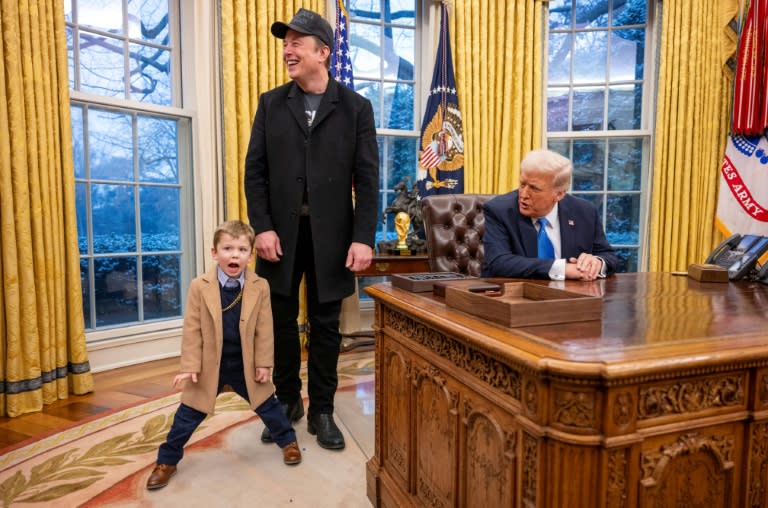
In a shocking move, Elon Musk made a surprise appearance at the White House, addressing mounting concerns over his growing influence on the nation’s capital. The billionaire entrepreneur and CEO of SpaceX and Tesla faced intense scrutiny over allegations of attempting a “hostile takeover” of the government. However, Musk vehemently denied these claims, asserting his commitment to collaborative governance and technological advancement. As the lines between public and private power continue to blur, Musk’s words have sparked a national conversation: what role should innovators play in shaping the country’s future?
Elon Musk, the world’s richest man, made a surprise appearance at the White House on Tuesday, denying allegations of a “hostile takeover” of the US government.
Standing alongside President Donald Trump in the Oval Office, Musk defended his cost-cutting plans, which aim to reduce the size and spending of the federal government.
President Trump then signed an executive order granting Elon Musk’s Department of Government Efficiency (DOGE) broader authority to reduce the federal workforce and requiring agency heads to comply with DOGE’s directives.
The agency has been criticised by Democrats who have accused it of a lack of transparency, and its efforts have also been hampered by legal challenges.
Doge has, for example, been blocked by a federal judge from accessing treasury records – in a case that seeks to ensure the agency does not interfere with funding signed off by Congress, which is outside Doge’s scope.
Elon Musk defended his proposed government cuts, calling them “common sense” measures that are reasonable and not extreme. When questioned by reporters for the first time since President Trump took office, Musk emphasized that his plans are pragmatic and necessary, rather than drastic or radical
“The people voted for major government reform and that’s what the people are going to get,” he said. “That’s what democracy is all about.”
“I fully expect to be scrutinised,” he added. “It’s not like I think I can get away with something.”
The billionaire technology entrepreneur, who himself was appointed and not elected, described federal workers as an “unelected, fourth, unconstitutional branch of government” that he said has “more power than any elected representative”.
The 53-year-old owner of Tesla, X and SpaceX wore a black Make America Great Again cap and cracked the occasional joke with reporters who asked him about his critics. He had his young son, named X Æ A-Xii – or X for short – on his shoulders for part of the news conference.
“It’s not optional for us to reduce the federal expenses,” Musk said. “It’s essential. It’s essential for America to remain solvent as a country.”
Musk was also asked about a recent false claim that the US government was sending millions of dollars worth of condoms to Gaza. “Some of the things that I say will be incorrect and should be corrected,” Musk replied.
In the early days of Trump’s presidency, Elon Musk has been leading the charge to downsize the federal government rapidly. As part of this effort, representatives from the Department of Government Efficiency (DOGE) have been monitoring spending across various departments, offering buyouts to millions of federal workers, and freezing funding for agencies like the US Agency for International Development (USAID) ¹.
Trump praised Musk’s work, claiming that they’ve uncovered “fraud and abuse” without providing concrete evidence. He estimated that the efforts would reveal over $1 trillion in wasteful spending, but didn’t elaborate further.
The vast cost-cutting drive has been criticised repeatedly by opponents including senior Democrats and those who say it will have significant repercussions both in the US and internationally.
“An unelected shadow government is conducting a hostile takeover of the federal government,” Senate Minority Leader Chuck Schumer said recently. He said Democrats would work to block Musk’s efforts by introducing specific language into spending bills.
But with Republicans holding a majority in both chambers of Congress, Trump’s agenda has faced more pressing hurdles in the courtroom.
“I hope that the court system is going to allow us to do what we have to do,” Trump said on Tuesday, referring to recent judgments that have temporarily halted his efforts to shrink government, including through an employee buyout programme.
Critics of Doge have raised concerns about potential conflicts of interest due to Musk’s extensive business ventures. Democrats have alleged that he may personally gain from certain policy changes proposed by the Trump administration.
In response, Musk stated that the public could form its own opinion on any potential conflicts. Trump added that if the White House perceived a lack of transparency or a conflict of interest, they would prevent Musk from participating in that segment or examining that area.
Trump signed an executive order directing Doge to “significantly” reduce the size of the federal workforce. The order also instructs government offices to develop plans for large-scale staff reductions.
Additionally, the order stipulates that once the hiring freeze Trump implemented on his first day in office is lifted, agencies should hire no more than one employee for every four who leave.
A recent CBS News poll, conducted in partnership with the BBC, found that while most Americans support Musk’s work, opinions vary on the extent of his influence. The poll indicated strong Republican backing for his efforts to cut federal spending and reduce foreign aid.
Trump’s policies received generally favorable ratings, but 66% of respondents expressed a desire for him to focus more on lowering prices.
One of the agencies most impacted by the cost-cutting measures is USAID. On Tuesday, the agency’s inspector general was dismissed, just one day after releasing a report criticizing plans to place the majority of staff on leave and shut down US-backed aid programs worldwide.
 The Fount
Leave a comment