

In a move that has raised eyebrows within the Nigerian Police Force, personnel have been mandated to contribute a staggering N3 billion to the Police Officers’ Wives Association (POWA) under the leadership of the wife of Inspector-General of Police, IGP Egbetokun. This directive has sparked concerns among police officers, who are already grappling with meagre salaries and poor working conditions.
The Nigeria Police Force has instructed its personnel to pay what it calls the “2025 Police Officers’ Wives Association dues.”
The Police Officers’ Wives Association is under the dedicated leadership of Elizabeth Egbetokun, the esteemed wife of the Inspector General of Police.
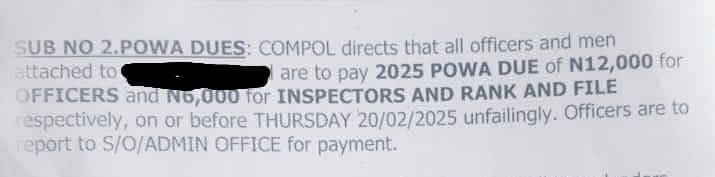
A signal from SaharaReporters reveals that Assistant Superintendents of Police (ASPs) are required to pay N12,000 each, while Inspectors and rank-and-file members must pay N6000 each. This payment structure is non-negotiable.
They are required to ensure the payment is made in cash, without exception, by the 20th of February, 2025. Timely compliance is essential.
“COMPOL directs that all officers and personnel are required to pay the 2025 POWA dues of N12,000 for officers and N6,000 for inspectors and rank and file, on or before Thursday, February 20, 2025, without fail. Officers are to report to the S/O/Admin Office to make the payment,” read the signal.
Nigeria currently has a police force consisting of just over 380,000 personnel.
However, some officers are protesting against certain mandatory payments, describing them as extortion and accusing them of being a means to enrich the Inspector General of Police’s wife.
“If the payment is lawful, it should be deducted directly from our salaries. They are asking officers of my rank and above to pay N12,000, while Inspectors down to Constables are required to pay N6000 nationwide. That amounts to over N3 billion in total,” an officer told SaharaReporters.
“There’s a mandatory POWA fee that is forced on all police officers now, and it’s illegal due to extortion,” an inspector added.
Attempts to contact Force spokesman Muyiwa Adejobi were unsuccessful; he did not answer calls or return messages.
Inspector General of Police Egbetokun is currently engaged in a contentious battle with senior police officers who are due for retirement, insisting that they leave the force. Interestingly, he is also set to retire in 2024.
On Friday, SaharaReporters exclusively reported that a mutiny is developing within the Nigeria Police Force, as more than 200 senior officers are refusing to retire despite being found to have falsified their birth records.
SaharaReporters has learned that some police officers have been serving for as long as 44 years, creating tensions between Inspector General Egbetokun and Deputy Inspector General Dasuki Galandanchi from the Federal Investigation Department.
Galandanchi is requesting a two-year extension of his service, citing the precedent set by Egbetokun, who was granted an extension despite being due for retirement last year.
Galandanchi is scheduled to retire next month; however, sources indicate that IG Egbetokun is not keen on keeping Galandanchi in the department due to concerns about his personal conduct and behaviour. Galandanchi has been described as having a reckless lifestyle and a larger-than-life demeanour.
“Galandanchi claims that if he must retire, Egbetokun should retire too,” said a source familiar with the situation in the Force. “He is in conflict with Egbetokun over this issue and has requested a two-year extension.”
On July 23, 2024, SaharaReporters reported that the Nigerian Senate approved a controversial amendment bill to extend the tenure of IGP Egbetokun beyond September.
The Nigerian Senate passed the Police Act (Amendment) Bill 2024, which amends the Police Act of 2020. President Bola Tinubu sent this amendment bill to the House of Representatives, proposing changes to the tenure of the Inspector General of Police (IGP).
On January 31, 2025, The Fount reported that the Police Service Commission (PSC) had approved the immediate retirement of senior police officers who were over 60 years old or had served in the force for 35 years. This decision was made at the PSC’s first extraordinary meeting.
 The Fount
Leave a comment