
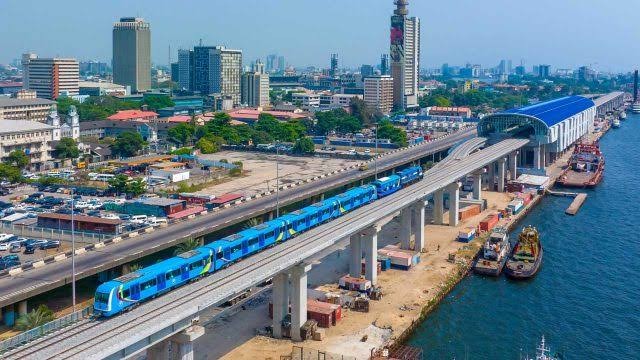
In a significant boost to Lagos State’s transportation infrastructure, the state government has signed a landmark agreement with the federal government to kick-start a 68-kilometer rail project. The ambitious project aimed at easing traffic congestion and enhancing connectivity will link key business districts, including Victoria Island, Lekki, and Ajah. Once completed, the rail line is expected to transform the state’s transportation landscape, promote economic growth, and improve the quality of life for residents.
The Lagos State Government has announced the signing of a Memorandum of Understanding (MoU) with the Federal Government to commence exploratory work on the 68-kilometer Green Line rail project.
This rail line will connect Marina to the Lekki Free Trade Zone and will pass through important areas such as Victoria Island, Lekki, and Ajah.
The announcement was made by Mr Gbenga Omotoso, the Lagos State Commissioner for Information and Strategy, during a Citizens/Media Stakeholders Forum organized by the Ministry on Monday.
He revealed that the agreement was signed with the Federal Government’s Ministry of Finance Incorporated (MOFI), as outlined in a statement posted on the official Facebook page of the Lagos State Government.
The Lagos State Government said it has signed an MoU with the Federal Government’s Ministry of Finance Incorporated (MOFI) to kickstart exploratory work on the development of the Green Line project,” the statement read in part.
The Green Line rail project aims to improve connectivity and foster economic activities along one of Africa’s fastest-growing industrial corridors, making a significant contribution to the state’s infrastructure and development.
The 68-kilometre Green Line, planned to connect the Lekki Free Trade Zone to Marina, is a pivotal element of the Lagos Strategic Transport Master Plan. This comprehensive initiative aims to establish a metro rail system with six Light Rail Transit (LRT) lines to enhance connectivity and ease traffic congestion across Lagos.
Significant progress has already been made on two of the proposed LRT lines, with passenger operations already active on the first phases of the Blue Line and the Red Line. The first phase of the Blue Line, spanning 13 kilometres from Marina to Mile 2, commenced operations in September 2023.
The Green Line rail project is expected to enhance connectivity and support economic activities along one of Africa’s fastest-growing industrial corridors, contributing significantly to the state’s infrastructure and development.
Similarly, the initial phase of the Red Line, covering 27 kilometres of its planned 37-kilometre route from Agbado in Ogun State to Oyingbo in Lagos, began operations in 2024. This phase of the Red Line includes eight strategically located stations: Agbado, Iju, Agege, Ikeja, Oshodi, Mushin, Yaba, and Oyingbo.
Construction is actively ongoing in the second phase of both the Blue and Red Lines, highlighting Lagos State’s commitment to expanding its rail infrastructure and meeting the transportation needs of its growing population.
The 2025 Federal Government Final Budget Proposal revealed that the Federal Government has allocated N146.14 billion as counterpart funding for the Lagos Green Line Metro Rail Project.
According to the budget document, this funding will be transferred to the Ministry of Finance Incorporated (MOFI), which will manage the counterpart funding on behalf of the Ministry of Transport for the project’s development. This allocation is part of the proposed N49.74 trillion budget for the 2025 fiscal year and falls under the budgetary provisions of the Ministry of Tr!! Transport1].
In September 2024, The Fount reported that the Lagos State Government formalized an agreement with MOFI and China Harbour Engineering Company (CHEC) for the development of the Green Line.
Under this agreement, MOFI and CHEC will oversee the design, financing, and operation of the project, which is viewed as a transformative step toward modernizing Lagos’s public transportation system and boosting economic activity in the region.
 The Fount
Leave a comment