
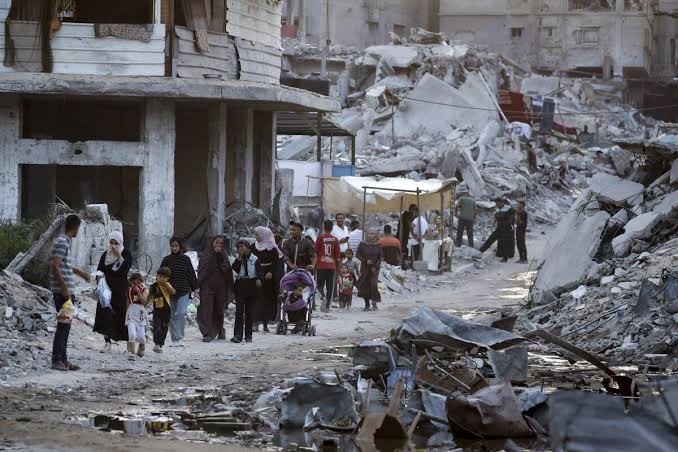
The Israeli military has announced plans to significantly expand its offensive in Gaza, intensifying airstrikes and ground operations across most of the territory. This escalation comes amid heightened tensions and violence, sparking concerns about the potential for widespread destruction, civilian casualties, and a deepening humanitarian crisis. As the situation unfolds, international attention focuses on the complex dynamics driving the conflict and the urgent need for a peaceful resolution to protect human lives and prevent further suffering.
Israel’s defence minister stated that the military would soon ‘vigorously’ expand its offensive across much of Gaza. Israel Katz also announced that the Israel Defence Forces (IDF) have completed the establishment of a ‘security zone’ in southern Gaza, effectively separating Rafah and Khan Younis.
The IDF issued evacuation orders for Khan Younis and adjacent areas, citing preparations for strikes in response to projectile launches from Gaza, for which Hamas claimed responsibility.
Israel recommenced its offensive against Hamas on March 18, following the termination of a two-month ceasefire.
Since the resumption of hostilities on March 18th, Israeli forces have taken control of significant portions of Gaza, resulting in the further displacement of hundreds of thousands of Gazan residents.
The Israeli military has established control over land along the entirety of the Palestinian territory’s borders, designating it as a buffer zone to mitigate potential attacks.
Israeli officials maintain that the current offensive is intended to exert pressure on Hamas to release the remaining 59 hostages held in Gaza, of whom 24 are believed to be alive.
On Saturday, Defense Minister Katz announced that the IDF had completed the takeover of the “Morag axis,” referring to the area of a former Jewish settlement situated between Rafah and Khan Younis. He stated that this action extends the Israeli security zone to encompass the region between the Philadelphia axis and Morag.
The takeover of the corridor effectively cuts the southern city of Rafah off from Khan Younis. Rafah makes up almost one-fifth of Gaza.
Katz also warned that “IDF activity will soon expand vigorously to additional locations throughout most of Gaza” and people in these areas “will have to evacuate the fighting zones.”
“This is the last moment to remove Hamas and release the hostages, and bring about an end to the war,” he stated.
He added that areas of northern Gaza, including the city of Beit Hanoun and the Netzarim Corridor – which cuts through central Gaza – were also being evacuated so that a “security zone” could be expanded there too.
“In northern Gaza as well – in Beit Hanoun and other neighbourhoods – residents are evacuating, the area is being taken over and the security zone is being expanded, including in the Netzarim corridor,” Katz stated.
When contacted for comment, the Israel Defense Forces (IDF) directed the BBC to the remarks made by the defence ministry.
Hamas, as quoted by AFP news agency, stated that the offensive “kills defenceless civilians” and “makes the fate of hostages ‘uncertain.’”
The United Nations Human Rights Office issued a warning last month, asserting that the evacuation orders issued by Israel did not adhere to international law.
The UN office accused Israel of failing to provide adequate accommodation or ensure satisfactory hygiene, health, safety, and nutritional conditions for those displaced.
The Israeli government responded, stating that the evacuation of civilians was conducted to protect them from harm and prevent their use as ‘human shields’ by Hamas, which they allege is a violation of international law.
Subsequent to Defense Minister Katz’s announcement, the Israeli military issued an evacuation order for residents of Khan Younis and its surrounding areas, citing preparations to respond to projectiles launched from Gaza earlier on Saturday.
The Israel Defense Forces (IDF) reported that their air defense systems intercepted three projectiles launched from Gaza towards Israeli territory. Hamas’s military wing subsequently claimed responsibility for the attack. No injuries were immediately reported.
According to the Hamas-run health ministry in Gaza, as of 13:00 local time (11:00 BST) on Saturday, 21 individuals had been killed and 64 injured within the preceding 24 hours.
The Israeli military initiated its campaign to dismantle Hamas following a cross-border attack on October 7, 2023, where approximately 1,200 individuals were killed and 251 others were taken hostage.
According to the Hamas-run health ministry in Gaza, the conflict has resulted in the deaths of over 50,933 people in the territory since its onset.
The ministry further reported that 1,563 of those fatalities occurred since March 18, when Israel resumed its offensive in the Gaza Strip.
 The Fount
Leave a comment