
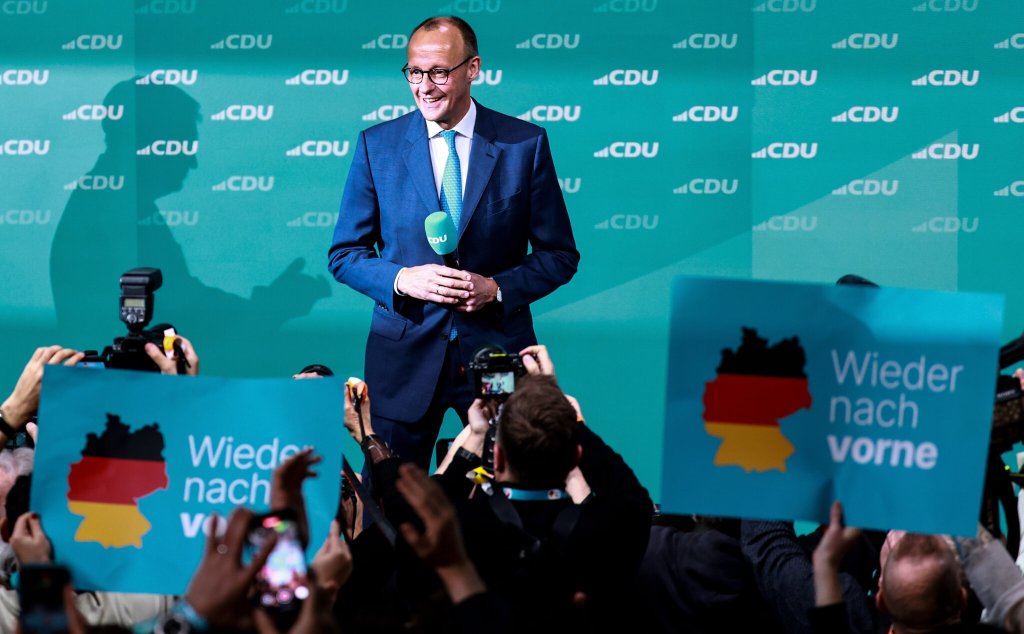
In a move poised to send shockwaves across the Atlantic, Germany’s new leader has signaled a profound shift in the country and Europe’s relationship with the United States, marking a potential turning point in the longstanding transatlantic alliance. As the European Union’s largest economy charts a new course, the implications are far-reaching, with experts predicting a significant impact on global politics, trade, and security.
Germany’s incoming chancellor wasted no time in declaring a new era for Europe, even before the final election results were announced on Sunday.
Friedrich Merz, questioning NATO’s future and urging Europe to rapidly strengthen its defenses, declared that the US had grown indifferent to the continent’s fate.
Such rhetoric from a staunch US ally — especially Merz, a devoted Atlanticist — would have been unthinkable just a few months ago.
It’s a monumental shift. That might sound like an exaggeration, but the current state of transatlantic relations is unlike anything we’ve seen in the 80 years since World War II ended.
Major European powers have been deeply shaken by the Trump administration’s suggestion that it might withdraw the security guarantees that have protected Europe since 1945.
Friedrich Merz stated during a post-election debate on Sunday; “I would never have thought that I would have to say something like this in a TV show but, after Donald Trump’s remarks last week… it is clear that this government does not care much about the fate of Europe,”
“My absolute priority will be to strengthen Europe as quickly as possible so that, step by step, we can really achieve independence from the USA,” He said.
Merz suggested that the situation was so urgent he was unsure if the transatlantic alliance leaders would have time to gather for their scheduled summit in June “would will still be talking about NATO in its current form or whether we will have to establish an independent European defense capability much more quickly”.
Here’s a refined version:
Notably, the incoming chancellor equated Donald Trump’s America with Russia, which is widely regarded as a broader security threat to Europe.
Notably, the incoming chancellor equated Donald Trump’s America with Russia, which is widely regarded as a broader security threat to Europe. “We are under such massive pressure from two sides that my absolute priority now really is to create unity in Europe,” Merz added.
Here’s a polished version:
The UK prime minister will travel to Washington on Thursday, following French President Emmanuel Macron’s visit on Monday. Friedrich Merz indirectly acknowledges a sense of FOMO — the fear of missing out — stating that Germany should also have a presence this week. As one of Europe’s Big Three powers, alongside France and the UK, Berlin’s absence is notable.
The UK prime minister will travel to Washington on Thursday, following French President Emmanuel Macron’s visit on Monday. Friedrich Merz indirectly acknowledges a sense of FOMO — the fear of missing out — stating that Germany should also have a presence this week. As one of Europe’s Big Three powers, alongside France and the UK, Berlin’s absence is notable.
And with the US and Russia now pow-wowing bilaterally, about, but not with, Ukraine, it feels like a global return to big-power politics.
But Germany has been MIA [missing in action] for a good while now on the European and the world stage. The outgoing government here was weakened and distracted by vicious internal bickering. This infuriated German voters – who wanted urgent focus on the economy and migration – and European allies, demanding action on Russia, security and defence.
Merz says a top priority for Germany is to re-engage internationally.
The country is already the second-biggest donor of military aid to Ukraine, after the US.
Merz wants to continue that support, but, unlike France and the UK, he’s been reticent about the idea of sending soldiers to Ukraine, to back up an eventual ceasefire there.
Based on Germany’s track record though – it dragged its heels at every stage of Ukraine support, and despite that, ended up delivering more aid than any of its European neighbours – a ‘No’ now, doesn’t mean a ‘No’ forever to committing troops or participating in whatever form a European “reassurance force” in Ukraine may take.
For now, the soldiers Germans are most concerned about are the 35,000 American troops stationed in their country, providing a sense of security.
Foreign policy rarely tops voter concerns during elections, but in Germany this weekend, alongside the economy and migration, many voters expressed deep anxiety about peace in Europe and a growing sense of insecurity.
In November, Germany’s interior ministry announced plans to compile a list of bunkers that could serve as emergency shelters for civilians.
While Ukraine may be geographically distant, Germans still feel deeply vulnerable to the Russian threat for two key reasons.
First, Germany’s extensive military support for Ukraine has heightened fears of retaliation. The far-right Alternative for Germany (AfD) party, with its “Germany First” slogan, has campaigned for Berlin to cut ties with Kyiv and rebuild relations with Moscow — a strategy reminiscent of Donald Trump’s approach, as the party frequently highlights.
Second, many Germans worry that if Russia sought to truly destabilize Europe, it might target one of the continent’s Big Three powers with a long-range missile.
France and the UK are nuclear powers. Germany is not. Even its conventional military is woefully understaffed and underequipped (to the immense irritation of European partners), so Germany fears it’s a soft target.
All the more so if President Trump withdraws his active servicemen and women from Germany.
He has pledged to significantly reduce US troop presence in Europe as a whole.
Germany’s growing sense of domestic insecurity led Friedrich Merz to propose creating a European nuclear umbrella with France and Britain, replacing the security guarantees currently provided by the United States.
While the idea makes for a powerful campaign promise, the reality is far more complex — raising difficult questions about military capabilities, long-term commitment, and strategic control.
The reality check: Merz’s vision for securing Germany and Europe would require substantial funding, at a time when Germany’s economy is struggling.
He would also need to negotiate with coalition partners in the next German government, as well as with key European allies like the UK — who may not be eager to adopt a confrontational stance toward the U.S.
This election could usher in stronger German leadership. But is the rest of Europe ready for it?
 The Fount
Leave a comment